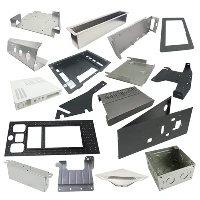
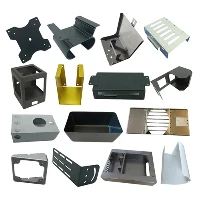

Causes and solutions of common burrs in blanking parts. Blanking is a stamping process that uses a mold to separate sheet materials. The most common defect of blanking parts is burrs. How to solve them? The main causes of burrs are as follows:
1. Gap: Burrs can occur if the punching gap is too large, too small or uneven. The following factors affect whether the gap is too large, too small or uneven:
A. Mold manufacturing errors-the processing of die parts does not conform to the drawings, the parallelism of the floor is not good, etc.;
B. Mold assembly errors - large gaps in the guide parts, non-concentric assembly of the convex and concave molds, etc.;
C. The accuracy of the press is poor-for example, the clearance between the press guide rails is too large, the parallelism between the bottom surface of the slider and the surface of the workbench is not good, or the perpendicularity between the slider stroke and the press table is not good, and the rigidity of the workbench is poor. Deflection during cutting can cause changes in the gap;
D. Installation error - if the surface of the upper and lower base plates of the punch die is not wiped clean during installation or the fastening method of the upper mold of a large punch die is improper, the installation of the upper and lower molds of the punch mold is not concentric (especially the mold without guide pillars), causing the working part to tilt;
E. The die structure is unreasonable - the die and working parts are not rigid enough, the punching force is unbalanced, etc.;
F. Curvature of the steel plate - the steel plate is uneven.
2. Blunt edge: Burrs can be produced if the edge is blunted due to wear or gnawing. Factors affecting edge dulling include:
A. The material and surface treatment of the convex and concave molds are poor and have poor wear resistance;
B. The die structure is poor and the rigidity is poor, causing gnawing injuries;
C. If it is not lubricated in time during operation, it will wear out quickly;
D. The cutting edge was not sharpened in time.
3. Improper punching state: If the blank (including intermediate parts) is not in good contact with the punch or die, when trimming and punching with improper positioning height, the height of the workpiece will also be lower than the positioning height. During the punching process, the shape of the workpiece and the shape of the cutting edge are not consistent, resulting in burrs.
4. Improper mold structure;
5. The material does not meet the process requirements: the material thickness is seriously out of tolerance or the wrong material (such as the wrong steel number) is used, causing the relative gap to be unreasonable and causing burrs to appear on the product.
6. The workmanship of the parts is poor
Squeals with complex shapes and convex or concave shapes are prone to wear too quickly and produce burrs.
The generation of burrs not only makes the deformation process after blanking easy to crack due to stress concentration, but also brings difficulties to the delamination of the blank in subsequent processes. Large burrs are easy to scratch the handle; when welding, the two steel plates are not well joined, and the welding is easy to penetrate and the welding is not strong; when riveting, it is easy to produce riveting gaps or cause riveting cracks.
Therefore, the occurrence of burrs outside the allowed range is extremely harmful. The existing burrs can be eliminated by filing, rolling, electrolysis, chemical treatment and other methods.
Nanpi Jian Tong Hardware Manufacturing Co., Ltd
+86-317-8851956
 Language


