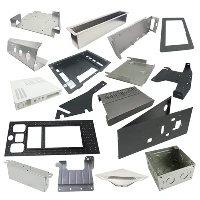
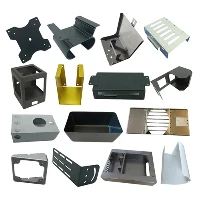
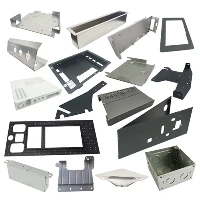

Various problems will occur more or less during the stamping process, and a large part of these problems are caused by very low-level errors. The following summarizes some common basic errors in the stamping process:
1. The upper die enters the lower die too deeply during stamping
When stamping, the depth of the upper die into the lower die should not be too large. Generally, it is appropriate to just punch the sheet. This depth can be 0.5-1mm. If the depth of the upper mold entering the lower mold is too large, the wear of the upper mold and the lower mold will be aggravated. If the mold guide and punch movement accuracy are not good, the mold edge will be damaged, especially when punching thick materials and small holes. When stamping at high speed, the depth of the stamping upper die into the lower die should not be too large. In order to prevent the upper mold from entering the lower mold too deeply, a limit sleeve can be installed on both sides of the upper mold to limit the depth of the upper mold into the lower mold. When grinding the upper mold, also grind the limit sleeve to the same grinding amount.
2. The stamping pressure center and the punch pressure center are eccentric
The point of action of the resultant stamping force is called the stamping pressure center. If the stamping pressure center and the punch pressure center (generally located on the axis of the die handle hole) are not on the same axis, the punch slide will bear an eccentric load, which will cause abnormal wear of the slide rail and the mold guide part, and damage the movement accuracy of the punch. , reduce the mold life, or even damage the mold. Therefore, determining the stamping pressure center is an important task in mold design. For workpieces with simple and symmetrical shapes, the action point of the stamping force is at its geometric center, and the pressure center does not need to be calculated. For workpieces with complex shapes and multi-process continuous stamping dies, the method of finding the action point of the resultant force of the parallel force system should be used to determine the stamping pressure center.
3. The punching force exceeds the nominal pressure of the punch press
The selection of stamping press is mainly based on stamping force. The principle is that the punching force cannot exceed the nominal pressure of the punch. The main factors affecting stamping force are material thickness and mechanical properties, peripheral length of stamping parts, die gap size and edge sharpness. When stamping high-strength materials or workpieces with large thickness and long stamping contour circumference (such as thick plate stamping), the required stamping force is often close to or exceeds the nominal pressure of the punch machine. When the factory has limited punch machines to choose from, this is the case. Consider ways to reduce the stamping force from the mold structure. The main methods to reduce stamping force include: inclined blade stamping method, stepped upper die stamping method, parts step-by-step stamping method, heated stamping method, etc. The oblique blade stamping method is to make the cutting edge of the upper die (when punching) or the lower die (when blanking) into a shape that is inclined at an angle to its axis. This angle is less than 150 degrees, and is generally 80 to 100 degrees with the oblique blade shear. Similar to cutting, the entire cutting edge does not contact at the same time, but cuts the material gradually, so the punching force is significantly reduced, and the vibration and noise during stamping can be reduced. Heated stamping is stamping (or red stamping) of materials in a heated state. Since the shear strength of metal materials generally decreases significantly when heated, it can effectively reduce the stamping force. However, the disadvantage of this method is that oxide scale is generated after the material is heated, which affects the surface quality of the parts. Therefore, it is generally used for stamping thick plates or stamping parts with low size and surface quality requirements. In addition, if the mold edge is blunt, chipped or not sharp, it will also significantly increase the stamping force. Therefore, maintaining a sharp edge is one of the conditions for the normal operation of the stamping die. In order to keep the cutting edge of the mold sharp, the cutting edge should be sharpened after the mold is stamped for a period of time.
4. There is a large cavity under the die base of the fixed upper mode fine punching die
The structural types of fine blanking dies can be divided into fixed upper mode fine blanking dies and movable upper mode fine blanking dies. Different mold structure forms require the punch worktable structure to match accordingly. For the movable upper-mode fine punching die, the workbench of the punch press is required to be fixed in the center and surrounded by a floating hydraulic workbench composed of annular cylinders and plungers. For fixed upper mode precision punching dies, the punch machine is required to have a plunger cylinder in the middle of the worktable, as shown in Figure 3-29. The characteristics of this mold structure are: the upper and lower dies are fixed on the lower mold base, and the edge ring maintains relative movement with the upper and lower molds through the power transmission rod and the mold base. The fixed upper mode fine punching die should not have a large cavity under the die base. This is because when the upper die is pressed down, the hydraulic cylinder moves downward under the action of the power transmission rod, so a large hole appears under the die base. There is a cavity, and all the stamping force acts on the top of the cavity, causing the upper and lower dies to bend, which is very unfavorable, and Japan. Under the influence of the increasing stamping force, the lower parts of the upper and lower dies are bent and there is a risk of cracking. In order to avoid this situation, when the stamping force is large, a special joint ring needs to be used to improve the support conditions of the lower die base and avoid large bends that cause the upper and lower dies to bend. As fine blanking technology develops towards large-scale and composite processes, it is necessary to punch multiple holes or large internal contours. The punching force is very large, and the required blank holder force and counter-pressure are both large. Therefore, the middle of the worktable of the punch machine is required.
5. Move the upper mode to fine punch parts with holes or large inner contours
The upper and lower dies of the movable upper mode fine blanking die are directly fixed at the center of the workbench, with good support conditions. The characteristics of this mold structure are: the upper and lower dies are movable relative to the mold base, and the upper and lower molds are guided by the inner holes of the mold base and the blank holder. The lower mold and the edge ring are fixed on the upper and lower mold seats respectively. The upper and lower molds maintain relative positions through the edge ring and the lower mold. Therefore, the gap between the upper and lower molds is required to be smaller. Only by making the upper and lower molds have a smaller gap Long guides and correct positioning ensure centering. Therefore, the movable upper-mode fine blanking die cannot punch parts with multiple holes or large internal contours. Because the mold assembly is difficult to center and the clearance is difficult to ensure, it is mainly suitable for fine blanking of medium and small parts.
6. The heat treatment hardness of the upper and lower molds of the stamping die is lower than 55HRC
The upper mold and lower mold of the stamping die are in contact with the stamping material, and are subject to greater force and wear faster. Therefore, the upper and lower molds of the stamping die must be heat treated, and the hardness cannot be lower than 55HRC, because the higher the hardness, the higher the strength of the mold and the more wear-resistant it is. Different mold steel materials have different heat treatment processes and hardness. Cold work die steel Cr12MoV and high-speed steel W18Cr4V2 have high heat treatment hardness, good hardenability, small quenching deformation, and no cracking. They are suitable for stamping parts with complex shapes, while T8A has good hardenability, but poor hardenability, and is prone to quenching deformation. Cracking is often used to punch parts with simple shapes and softer shapes. Since the processing of the lower mold is more difficult than that of the upper mold, the hardness of the lower mold is higher than that of the upper mold, generally 2-3 Rockwell hardnesses higher. That is, the heat treatment hardness of the upper mold is generally 58~60HRC, and the heat treatment hardness of the lower mold is 60~62HRC.
Nanpi Jian Tong Hardware Manufacturing Co., Ltd
+86-317-8851956
 Language


