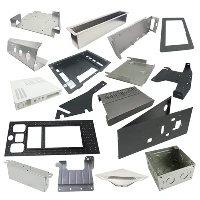
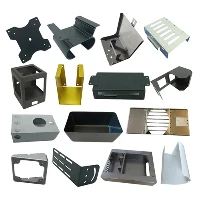
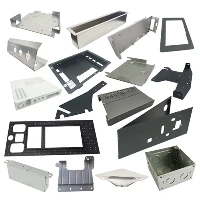

Common problem solving methods for stamping parts:
1. Adhesion and scratches: Defects on the surface of the workpiece or mold due to friction between the material and the punch or die;
2. Burrs: Mainly occur in shearing dies and blanking dies, and the gap between the cutting edges is large or small, which will produce burrs;
3. Line deviation: When the workpiece is formed, the part that contacts the mold first is squeezed and forms a line;
4. Concave and convex: Concave and convex are caused by foreign matter (iron filings, rubber, dust) mixed in the unwinding line;
5. Bending: Due to uneven stress, poor matching of draw ribs or poor control of the press slider, the r corner or embossed part of the workpiece is bent and strained;
6. Wrinkles: Wrinkles on the edge or r part are caused by poor adjustment of the press slider, low press precision, improper adjustment of the air cushion pressure, large r part of the punch, etc. 7. Other specific issues: In daily production, the punching size is too large or too small (may exceed the standard requirements) and the size is quite different from the punch. In addition to considering the design size, processing accuracy and blanking clearance of the forming convex and concave dies, the following aspects should be considered to solve the problem.
⑴. When the punching edge is worn, the tensile stress on the material increases, and the tendency of the stamping part to flip and distort increases. When flipping occurs, the punching size will decrease.
⑵. The strong pressure on the material causes the material to undergo plastic deformation, which will lead to a larger punching size. When the strong pressure is reduced, the punching size will decrease.
⑶. The shape of the end of the punch edge. If the end is trimmed with a bevel or arc, the punching part is not easy to flip or distort because the blanking force is reduced, so the punching size will increase. When the end of the punch is flat (without a bevel or arc), the punching size will be relatively small.
8. Methods to suppress flipping and distortion of stamping parts
⑴. Reasonable mold design. In the progressive die, the organization of the blanking sequence may affect the forming accuracy of the stamping parts. For the blanking of small parts of the stamping parts, it is generally necessary to organize the blanking of a larger area first, and then organize the blanking of a smaller area to reduce the impact of the blanking force on the forming of the stamping parts.
⑵. Press the material. Overcoming the traditional mold design structure, a material storage gap is opened on the discharge plate (that is, when the mold is closed, the material can be pressed. For the key forming parts, the discharge plate must be made into an insert structure to facilitate the solution of the wear (pressure) damage caused by long-term stamping on the discharge plate pressing part, and the material cannot be pressed.
⑶. Add a strong pressure function. That is, the thickness of the discharge insert pressing part is thickened (the normal discharge insert thickness H+0.03mm) to increase the pressure on the material on the die side, thereby suppressing the occurrence of flipping and distortion of the stamping parts during punching.
⑷. The end of the punch edge is trimmed into a bevel or arc. This is an effective way to reduce the buffer shear force. Reducing the buffer shear force can reduce the tensile force on the die side material, thereby achieving the effect of suppressing the occurrence of material flipping and distortion of the stamped parts.
⑸. In daily mold production, attention should be paid to maintaining the sharpness of the punch and die edges. When the punch edge is worn, the tensile stress on the material will increase, and then the tendency of the stamped parts to flip and distort will increase.
⑹. Unreasonable or uneven punching gaps are also the causes of flipping and distortion of stamped parts, which need to be overcome.
Nanpi Jian Tong Hardware Manufacturing Co., Ltd
+86-317-8851956
 Language